

Table of Contents
You’ve probably already spent hours rereading notes, highlighting textbooks, and reviewing the same chapters before an exam. The problem is that more study time does not automatically create better memory, especially when your study sessions rely mostly on passive review. In this guide, you’ll learn how to improve memory when studying with active recall, spaced repetition, practice testing, better focus, sleep, and a practical study routine.
Key Takeaways
- Memory improvement for studying involves learning information effectively, retaining it over time, and retrieving it when needed.
- Active recall strengthens learning by requiring you to retrieve information from memory instead of repeatedly rereading material.
- Spaced repetition improves long-term retention by spreading review sessions across increasing intervals.
- Practice testing helps identify knowledge gaps while giving you repeated opportunities to retrieve information.
- Sleep, focused attention, physical activity, and study breaks support the learning and memory processes needed for effective studying.
- Flashcards, practice questions, mnemonics, and self-explanation make study sessions more active when used correctly.
- Consistent review is generally more useful for long-term retention than trying to memorize everything in one long session.
What Is Memory Improvement When Studying?
Memory improvement for studying is the process of using effective learning and retrieval strategies to encode, retain, and recall information more reliably. In simple terms, it means getting better at learning something today and still being able to retrieve it later.
First, studying involves more than simply putting information into your brain. Encoding is the process of taking in information, while retention involves maintaining it and retrieval involves bringing it back when you need it.
For example, reading the definition of photosynthesis is encoding, remembering the definition three days later is retention, and explaining it during an exam is retrieval.
At the same time, working memory and long-term memory play different roles. Working memory temporarily holds and manipulates information, while long-term memory stores knowledge that can potentially be retrieved later.
For example, when solving a mathematics problem, you may temporarily hold several numbers in working memory while relying on long-term memory for formulas and concepts.
A useful way to think about studying is therefore:
Learn → retrieve → receive feedback → review later → retrieve again.
Why Does Improving Memory Matter for Studying?
Improving memory matters for studying because stronger retention and retrieval make your study time more productive. Instead of repeatedly relearning the same information, you can spend more time strengthening knowledge that you already understand.
First, effective retrieval practice can produce stronger learning than additional studying alone. A well-known study comparing retrieval practice with concept mapping found greater meaningful learning from retrieval practice on later tests. — Source: [Karpicke & Blunt, 2011]
For example, reading a biology chapter three times may make the material feel familiar, but closing the book and answering ten questions forces you to discover what you can actually remember.
Moreover, spaced learning can improve retention compared with concentrating study into one session. A recent classroom-learning meta-analysis found a moderate advantage for distributed practice over massed practice, with d = 0.54 across 22 reports involving more than 3,000 learners. — Source: [Mawson & Kang, 2025]
For example, studying vocabulary for 20 minutes on four different days is often a better long-term strategy than studying it for 80 minutes once.
Better memory reduces the need to constantly start from zero. That can make exam preparation more efficient and give you more time for difficult topics.
How Can You Improve Memory When Studying?
You can improve memory when studying by combining active recall, spaced repetition, practice testing, elaboration, self-explanation, chunking, mnemonics, and teaching. These methods turn studying from passive exposure into active learning.
How Does Active Recall Improve Memory When Studying?
Active recall involves retrieving information from memory without looking at the answer, which makes it more effective for learning than simply rereading material repeatedly. Retrieval practice has repeatedly been shown to strengthen later retention. — Source: [Karpicke, 2010]
First, active recall can be extremely simple. Read a small section, close your book, and write everything you can remember without checking your notes.
For example, after studying the causes of World War I, ask yourself: “What were the major causes, and how did each contribute to the conflict?”
Next, check your answer against your notes. Correct your mistakes immediately, then attempt the question again later.
A practical active-recall cycle is:
- Read and understand a small section.
- Close the textbook.
- Recall the main ideas.
- Write or say your answer.
- Check for errors.
- Correct the gaps.
- Repeat after a delay.
How Does Spaced Repetition Help You Remember Study Material?
Spaced repetition involves reviewing information at gradually increasing intervals to strengthen long-term retention and reduce forgetting. Research involving hundreds of experiments has found substantial evidence for distributed practice, with the ideal spacing depending partly on how long you need to remember the material. — Source: [Cepeda et al., 2006]
For example, instead of reviewing a new topic five times on Monday, you could review it on Monday, Tuesday, Thursday, and the following week.
A simple schedule could look like this:
| Review | Suggested timing | Main goal |
|---|---|---|
| Review 1 | Same day | Establish the memory |
| Review 2 | Next day | Retrieve weak points |
| Review 3 | 3–4 days later | Strengthen recall |
| Review 4 | 1 week later | Test retention |
| Review 5 | 2–4 weeks later | Maintain long-term memory |
Moreover, research on spaced retrieval shows that repeated retrieval combined with spacing can strengthen long-term retention. — Source: [Karpicke & Bauernschmidt, 2011]
How Can Practice Tests Improve Long-Term Memory?
Practice testing involves answering questions or completing problems from memory so students can strengthen retrieval and identify gaps in their knowledge. A meta-analysis covering 122 experiments and more than 10,000 participants found that testing produced transferable learning benefits compared with simple re-exposure. — Source: [Pan & Rickard, 2018]
First, practice tests should not be reserved for the night before an exam. Use them throughout the learning process.
For example, after studying a chemistry chapter, answer practice questions without looking at your notes. Mark each answer and review the concepts behind every mistake.
A practice test is both a learning tool and a diagnostic tool. It tells you what you know, what you only recognize, and what you need to study again.
Is Rereading an Effective Way to Remember What You Study?
Rereading can help you become familiar with material, but rereading alone is usually weaker than actively retrieving and applying what you learned. The problem is that familiarity can create an illusion of mastery.
For example, a paragraph may look extremely familiar after three readings, but you may struggle to explain its main idea when the textbook is closed.
Instead of:
Read → reread → highlight → reread
Try:
Read → close the book → recall → answer questions → check → review later.
That small change makes your brain work harder in a way that directly resembles the demands of an exam.
How Can You Memorize Difficult Study Material More Easily?
First, use elaboration by asking questions such as why, how, what causes this, and how is this different? For example, instead of memorizing that insulin regulates blood glucose, ask how insulin changes glucose movement and why that matters.
Second, use self-explanation by explaining each step in your own words. If you cannot explain a concept simply, that usually signals a knowledge gap.
Third, use chunking to group related information. For example, instead of memorizing twelve unrelated historical dates, organize them into three periods and attach major events to each period.
Fourth, use mnemonics when the material is suitable for them. Acronyms, vivid mental images, stories, and associations can provide useful retrieval cues.
Meaningful connections make information easier to retrieve than isolated facts.
Finally, teach the concept to another person. Teaching forces you to organize information, identify gaps, and explain relationships rather than merely recognizing familiar words.
How Do Sleep, Focus, Exercise, and Study Breaks Affect Memory?
Sleep, focused attention, physical activity, and well-timed breaks support the conditions needed for effective learning and memory. Strong study techniques work better when your brain and body are not constantly fighting fatigue and distraction.
How Does Sleep Affect Memory and Learning?
Sleep supports attention, concentration, and academic performance, making adequate sleep an important part of effective studying. The CDC notes that students need appropriate sleep to help with focus and concentration, while U.S. high-school students are generally recommended to get at least eight hours each night. — Source: [CDC, 2024]
For example, sacrificing several hours of sleep to cram before an exam may give you more study time but leave you tired and less focused the next day.
Moreover, CDC data found that students with higher grades were more likely to report getting eight or more hours of sleep. This is an association rather than proof that sleep alone causes higher grades. — Source: [CDC, 2024]
How Can You Stay Focused While Studying?
Focused attention improves studying because information cannot be effectively learned when your attention is repeatedly interrupted. A distraction-free environment makes it easier to process information deeply and retrieve it later.
First, remove obvious interruptions before beginning. Put your phone away, close unnecessary browser tabs, and choose one clearly defined task.
For example, instead of studying “biology” for two hours, set a target such as “learn the five stages of mitosis and answer 15 practice questions.”
Next, use a short focused block such as 25–50 minutes followed by a brief break. The exact timing is less important than maintaining genuine focus during the work period.
Does Exercise Help Memory and Learning?
Physical activity may support cognitive function and memory, making movement a useful complement to effective study habits. A 2025 umbrella review covering 133 systematic reviews, 2,724 randomized controlled trials, and 258,279 participants found significant improvements associated with exercise in general cognition, memory, and executive function. — Source: [Singh et al., 2025]
For example, taking a brisk walk between study blocks can provide a physical reset instead of spending every break scrolling on your phone.
That being said, exercise should complement—not replace—effective learning methods such as retrieval practice and spaced review.
How Should You Use Study Breaks?
Study breaks work best when they restore attention without turning into long periods of distraction. A short walk, stretching, water break, or quiet rest can be more useful than opening an endless social-media feed.
For example, after a 45-minute focused session, spend five to ten minutes moving around before returning to your work.
A good break protects the next study session instead of consuming it.
What Study Tools and Examples Can Help Improve Memory?
The best study tools are those that make retrieval, spacing, feedback, and organization easier. A tool is useful when it supports an effective learning method rather than simply making notes look attractive.
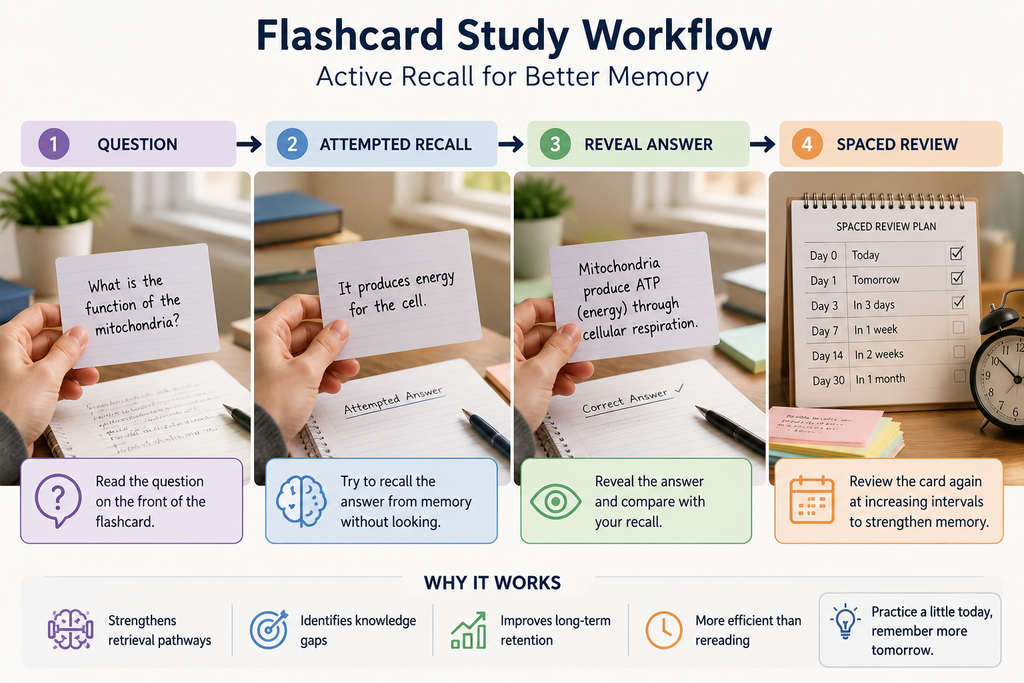
How Can Flashcards Improve Memory?
Flashcards can support active recall when you attempt the answer before revealing it. The important part is not the card itself but the retrieval effort required to answer it.
For example:
Front: What are the three branches of the U.S. government?
Back: Legislative, executive, and judicial.
Instead of flipping immediately, pause and retrieve the answer first.
How Can Practice Questions and Mind Maps Help?
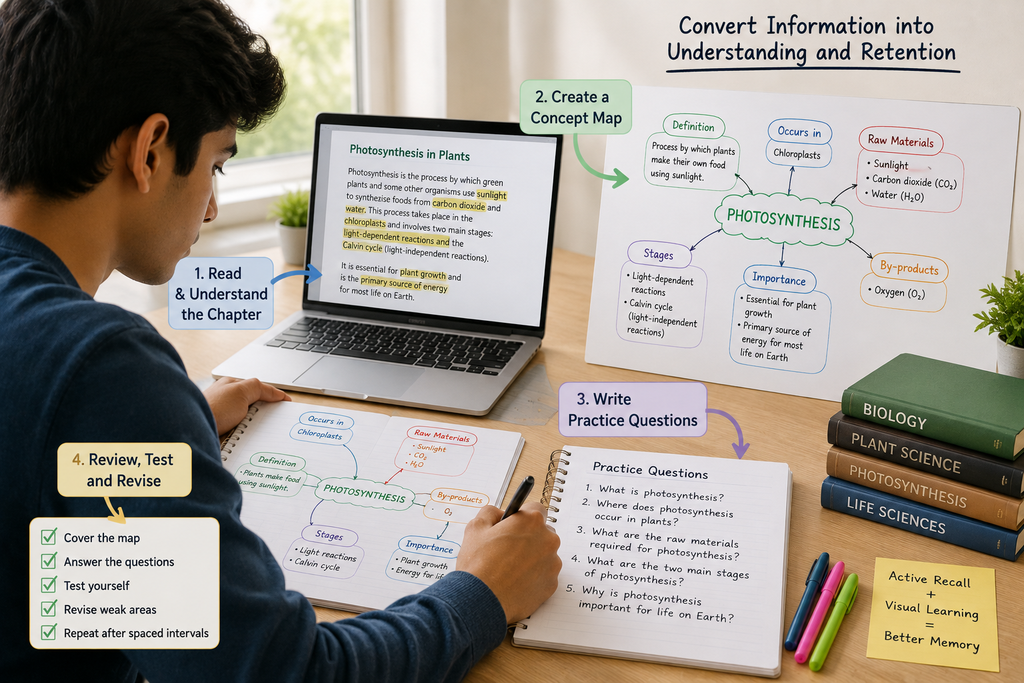
Practice questions reveal knowledge gaps, while mind maps can help organize relationships among concepts. Use practice questions when retrieval is the priority and mind maps when structure or relationships are difficult to understand.
For example, a mind map for an economics chapter could place inflation at the center and connect causes, effects, measurements, and policy responses.
How Can Digital Spaced-Repetition Tools Be Used?
Digital spaced-repetition tools can automate review scheduling, but they work best when the cards require genuine retrieval. You can also create paper flashcards or use a simple spreadsheet if you prefer a low-tech approach.
For example, a good card asks one clear question and requires a specific answer rather than copying an entire textbook paragraph.
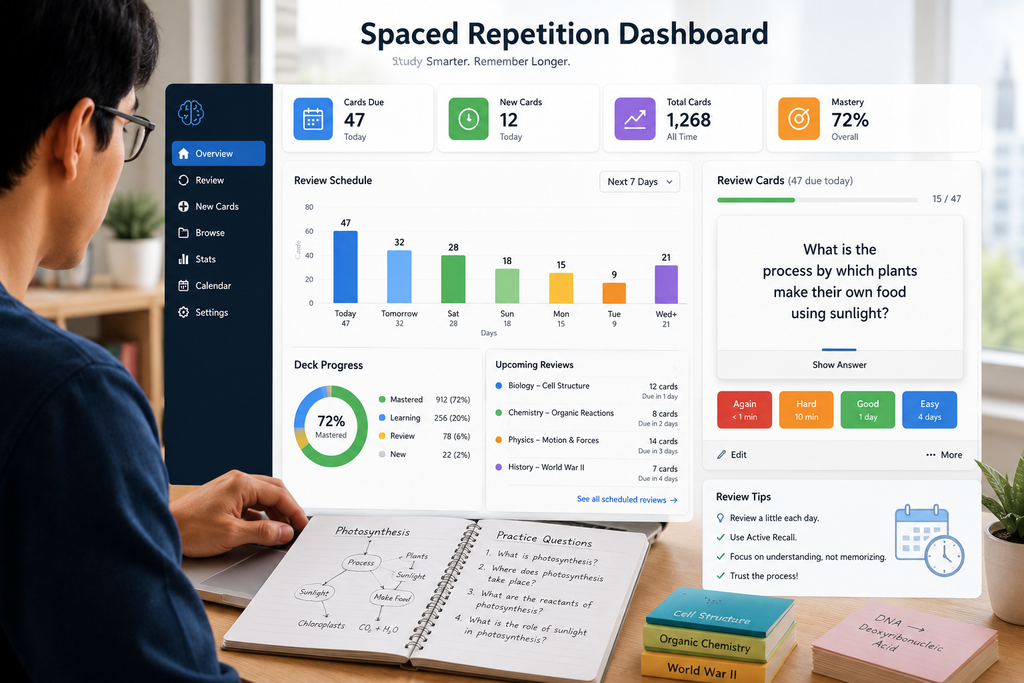
Free alternatives include paper flashcards, a spreadsheet, or a simple question-and-answer document. The learning principle matters more than the software.
What Is the Best Study Routine for Improving Memory?
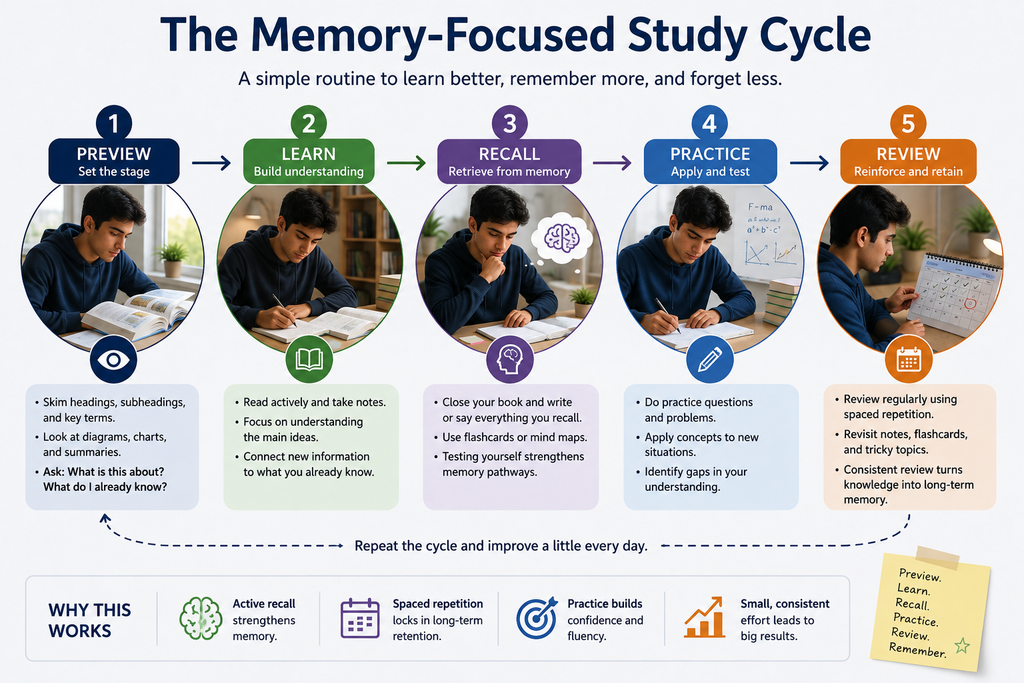
What Should You Do During One Study Session?
First, preview the material for two to five minutes. Identify headings, learning objectives, formulas, diagrams, and difficult terms.
Second, learn a small section with focused attention. Avoid trying to memorize an entire chapter at once.
Third, close the book and retrieve the key ideas. Write what you remember without checking.
Fourth, practice the material using questions, problems, flashcards, or short explanations.
Fifth, check your answers and correct mistakes. Feedback is important because incorrect retrieval should not be allowed to become your final memory.
Sixth, schedule a later review instead of assuming today’s session is enough.
What Does a Simple Daily Memory Schedule Look Like?
A simple daily schedule can divide learning, retrieval, practice, and review into manageable blocks.
| Time | Activity | Memory goal |
|---|---|---|
| 9:00–9:10 | Preview | Build a mental framework |
| 9:10–9:40 | Learn | Understand new material |
| 9:40–9:50 | Active recall | Retrieve without notes |
| 9:50–10:00 | Break | Restore attention |
| 10:00–10:30 | Practice | Apply knowledge |
| Evening | Quick recall | Strengthen retrieval |
| Next day | Spaced review | Prevent forgetting |
For example, a student studying anatomy could learn one body system in the morning, recall it without notes, answer practice questions, and review the same information briefly the following day.
The goal is not to study every waking hour. The goal is to make each study period produce useful retrieval opportunities.
What Should You Do Next to Improve Your Study Memory?
The fastest practical way to improve your study memory is to replace passive rereading with a structured cycle of retrieval and spaced review. You do not need to change every habit at once.
How Can You Improve Memory in 7 Days?
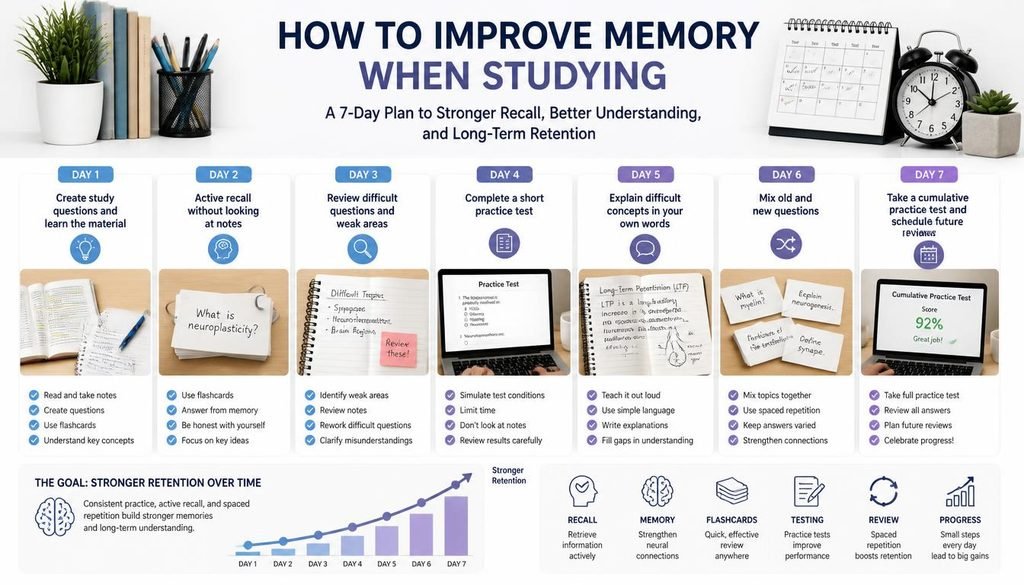
First, use this seven-day reset:
Day 1: Choose one subject and convert your notes into questions.
Day 2: Study the questions using active recall and mark weak areas.
Day 3: Review yesterday’s difficult questions and add new material.
Day 4: Complete a short practice test without notes.
Day 5: Revisit mistakes and explain difficult concepts aloud.
Day 6: Mix old and new questions to practice retrieval across topics.
Day 7: Take a cumulative practice test and schedule the next reviews.
For example, if you have an upcoming biology exam, you could create 20 questions on Day 1 and gradually combine those questions with new chapters throughout the week.
How Can You Stop Forgetting What You Study?
You can reduce forgetting by reviewing information after delays instead of repeatedly studying it during one session. A practical pattern is same-day recall, next-day review, several-day review, and later cumulative testing.
Moreover, track your mistakes. Your weakest questions deserve more retrieval opportunities than questions you can already answer confidently.
Conclusion: How to Improve Memory When Studying Effectively
Better memory comes from better study methods, not simply from spending more hours with a textbook. Active recall, spaced repetition, practice testing, meaningful explanations, focused attention, adequate sleep, exercise, and sensible breaks can work together to improve how you learn and retrieve information.
First, start with one change: close your notes and test yourself after every study session. Then add spaced reviews so the information is retrieved again after a delay.
Moreover, remember that forgetting is not proof that you are bad at learning. Forgetting shows you where another retrieval opportunity can strengthen the memory.
The most effective study routine is one that repeatedly makes you retrieve, apply, correct, and revisit what you have learned.
If you want to improve your study memory, start today with one chapter, ten questions, and a review scheduled for tomorrow.
Written by: myserioi.com Editorial Team — Educational and learning-content writers focused on practical, evidence-informed study strategies.
Reviewed by: myserioi.com Editorial Review Team — Review focused on educational accuracy, evidence-based learning principles, and reader-friendly presentation.
Disclaimer: This article was initially drafted using AI assistance. However, the content has undergone thorough revisions, editing, and fact-checking by human editors and subject matter experts to ensure accuracy.
Affiliate Disclosure
Some links on MySeriOI may be affiliate links. If you purchase a product or service through one of these links, we may earn a commission at no additional cost to you.
We only recommend products, tools, or services that we believe may provide value to our readers. Our opinions and recommendations remain independent.