

Table of Contents
You may already know that stress can make it harder to sleep, especially when your mind keeps replaying worries as soon as your head hits the pillow. What you may be missing is a simple way to reduce that mental and physical alertness instead of trying to force yourself to sleep. This guide explains what to do tonight, which relaxation techniques can help, and how to build habits that make falling asleep easier when stress strikes.
Key Takeaways
- Stress-related sleeplessness occurs when mental or physical stress keeps the body and mind more alert at bedtime.
- Relaxation techniques such as slow breathing, progressive muscle relaxation, and mindfulness can help reduce bedtime arousal.
- A consistent bedtime routine can make the transition from wakefulness to sleep easier.
- Writing down worries and tomorrow’s tasks can help separate nighttime rest from problem-solving.
- Reducing caffeine, bright light, stimulating activities, and excessive screen use near bedtime can support healthier sleep habits.
- Forcing yourself to sleep can increase frustration, so calming the body and reducing stimulation is often more useful.
- Persistent sleep difficulties or significant daytime problems should be discussed with a qualified healthcare professional.
What Is Stress-Related Difficulty Falling Asleep?
Stress-related sleeplessness is difficulty falling asleep or staying asleep when psychological or physical stress increases mental or bodily alertness at bedtime. Occasional difficulty sleeping during a demanding week is different from persistent insomnia, which involves ongoing sleep problems and daytime consequences.
Moreover, stress-related sleeplessness can feel like being exhausted but unable to switch off. For example, you might finish a difficult workday, get into bed, and suddenly start thinking about tomorrow’s meeting, finances, family responsibilities, or unfinished tasks.
In addition, sleep difficulties are common among adults. In the United States, 15.4% of adults reported trouble falling asleep most days or every day in 2024 — Source: [National Center for Health Statistics, 2026].
Furthermore, occasional stress does not automatically mean you have insomnia. A persistent pattern that affects daytime functioning deserves a more careful evaluation, particularly when sleep problems continue despite having enough opportunity to sleep.
Why Does Stress Make It Hard to Fall Asleep?
Stress makes it harder to fall asleep because it can keep your mind and body in a more alert state when sleep requires a gradual reduction in arousal. Worry can keep your attention focused on problems, while physical tension can make relaxation more difficult.
For example, someone worried about an important presentation may mentally rehearse possible mistakes while lying in bed. Instead of moving toward sleep, the brain remains focused on preparation and problem-solving.
At the same time, worrying about sleep can create another layer of stress. You may think, “I only have five hours left, so I must fall asleep now,” which can make sleep feel like a task that must be completed.
Moreover, research on insomnia suggests that sleep effort and sleep reactivity can contribute to the persistence of sleep difficulties after stressful periods — Source: [Sleep Health research, 2024].
As such, the goal is not to force sleep. The goal is to reduce stimulation and create conditions in which sleep can happen naturally.
How Can You Fall Asleep When You Are Stressed?
You can fall asleep more easily when stressed by gradually reducing stimulation, calming your breathing, releasing physical tension, and stopping active problem-solving before bed. A simple routine is often more useful than trying several complicated sleep hacks at once.
What Should You Do 60 Minutes Before Bed?
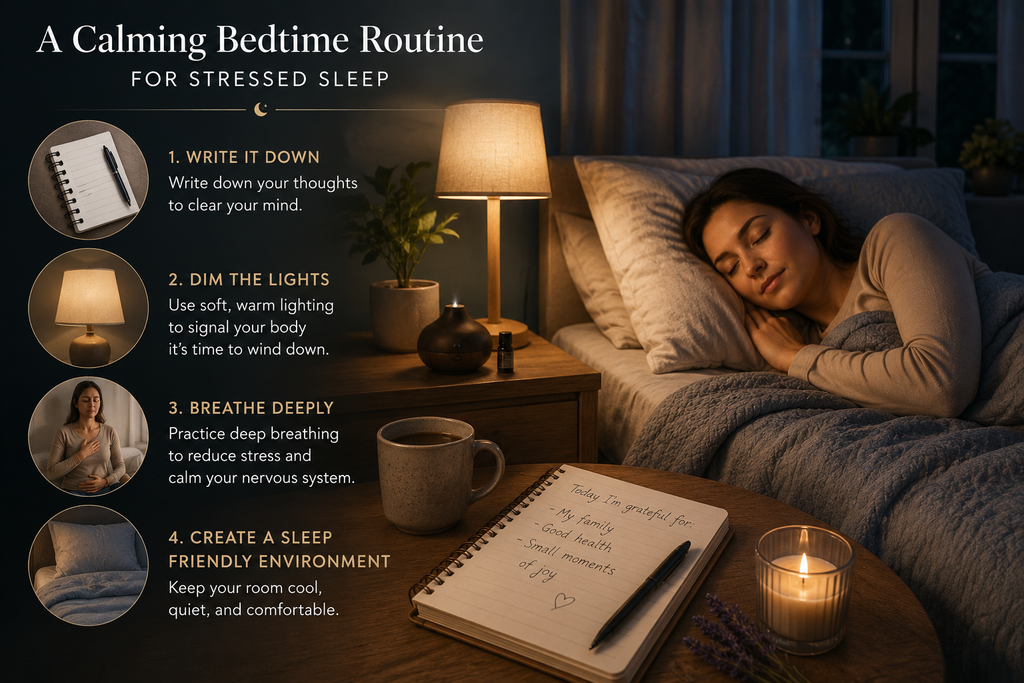
The hour before bed should become a transition period rather than another productive work period. Dimming the environment and switching from stimulating activities to quieter ones can help establish a consistent signal that the day is ending.
First, try this simple sequence:
- Finish demanding tasks. Stop work, studying, intense discussions, and complicated planning.
- Dim bright lights. Make your environment quieter and less stimulating.
- Put stimulating devices aside. Avoid using your bed as a workplace or entertainment center.
- Write down unfinished thoughts. Move tomorrow’s tasks onto paper.
- Take a warm shower or bath. Use it as a relaxing transition rather than a rushed task.
- Practice slow breathing. Spend several minutes breathing comfortably and slowly.
- Go to bed when you feel sleepy. Do not treat bedtime as a test of willpower.
How Can You Create a Sleep-Friendly Bedroom?
A sleep-friendly bedroom is cool, quiet, dark, comfortable, and reserved primarily for sleep. These environmental conditions reduce common sources of stimulation that can interfere with winding down.
For example, the NHLBI recommends a cool, quiet, dark bedroom and advises avoiding electronic devices that can disrupt the sleep-wake cycle — Source: [National Heart, Lung, and Blood Institute, 2022].
Therefore, consider lowering unnecessary noise, reducing bright light, adjusting the room temperature, and keeping work materials away from the bed.
How Can You Calm a Racing Mind Before Bed?
A racing mind is best handled by reducing nighttime problem-solving rather than trying to force every thought to disappear. Your objective is to give your brain a clear boundary between planning time and sleeping time.
Can Writing Down Worries Help You Sleep?
Writing down worries and tomorrow’s tasks can help move problem-solving out of bedtime and create a clearer mental boundary around sleep. The technique does not require a long journal entry or perfect explanation.
For example, write three short sections:
- What is worrying me?
- What can I do about it tomorrow?
- What does not need to be solved tonight?
Then create one practical next step for each problem. If you are worried about an email, your note might say, “Draft response at 9:00 a.m.” You have not solved the issue, but you have created a plan.
In addition, keep the exercise brief. The purpose is to unload thoughts, not create another nighttime project.
How Can Mindfulness Help With Racing Thoughts?
Mindfulness before sleep involves noticing thoughts without repeatedly following or solving them. Instead of arguing with a worry, you can acknowledge it and gently return attention to breathing, body sensations, or another neutral focus.
For example, when you think, “What if tomorrow goes badly?”, you can notice, “I am having a worry about tomorrow,” and return attention to your breathing.
That being said, mindfulness does not require an empty mind. A successful relaxation exercise can include thoughts; the important part is repeatedly redirecting attention without judging yourself.
What Breathing Exercises Can Help You Relax Before Sleep?
Slow, comfortable breathing can be used as a relaxation technique because it gives your attention a simple focus and can help reduce physical tension. You do not need to use an extreme breathing pattern or hold your breath for long periods.
How Do You Practice Diaphragmatic Breathing for Sleep?
Diaphragmatic breathing involves breathing gently so the abdomen moves naturally rather than forcing large breaths into the chest. The exercise should feel comfortable and should never make you dizzy or uncomfortable.
Try this:
- Lie down or sit comfortably.
- Relax your shoulders and jaw.
- Place one hand lightly on your abdomen.
- Breathe in gently through your nose.
- Allow your abdomen to expand naturally.
- Exhale slowly without forcing the breath.
- Repeat for several minutes.
For example, instead of counting aggressively, simply notice the sensation of inhaling and exhaling. If your mind wanders, return attention to the next comfortable breath.
Relaxation techniques for sleep work by helping reduce mental and physical arousal so the body can transition from wakefulness toward sleep. Relaxation therapy is also included among behavioral approaches used for insomnia — Source: [American Academy of Sleep Medicine, 2020].
Can Progressive Muscle Relaxation Help You Fall Asleep?
Progressive muscle relaxation is a technique that systematically releases muscle tension by briefly tensing and then relaxing different muscle groups. It can be useful when stress leaves your shoulders, jaw, hands, or legs feeling tense.
For example, begin with your feet and gradually move upward toward your face. Gently tense one area for a few seconds, release it, and notice the difference between tension and relaxation.
Next, move through your calves, thighs, abdomen, hands, shoulders, neck, and face. Keep the contractions gentle rather than forceful.
Moreover, relaxation therapy is recognized as a behavioral approach that can target both physical tension and cognitive arousal associated with sleep problems — Source: [American Academy of Sleep Medicine, 2020].
What Should You Do If Stress Keeps You Awake at Night?
If stress keeps you awake, avoid turning the bed into a place for prolonged worrying, clock-watching, or stimulating activities. Instead, keep the environment calm and use a low-stimulation activity until you feel sleepy again.
Should You Get Out of Bed If You Cannot Fall Asleep?
Getting out of bed when you cannot sleep is a recognized stimulus-control strategy used in behavioral treatment for insomnia. The aim is to strengthen the association between bed and sleep rather than repeatedly pairing the bed with frustration.
For example, if you have been awake and increasingly frustrated, leave the bed and sit somewhere comfortable with dim lighting. Read something quiet or practice relaxed breathing, then return to bed when you feel sleepy.
The NHLBI describes stimulus control as part of CBT-I and recommends getting out of bed when you cannot sleep so that the bed becomes more strongly associated with sleeping — Source: [National Heart, Lung, and Blood Institute, 2022].
What Should You Avoid Before Bed When You Are Stressed?
Avoiding late-day stimulants and highly activating activities can make it easier to create a calm transition into sleep. Common factors to review include caffeine, nicotine, alcohol, intense late-night exercise, bright light, and stimulating screen activity.
| Habit | Why it may interfere | Better approach |
|---|---|---|
| Late caffeine | Can increase alertness | Keep caffeine earlier in the day |
| Work in bed | Associates bed with mental activity | Use a separate workspace |
| Clock watching | Can increase sleep-related worry | Turn the clock away |
| Bright screens | Can increase stimulation | Dim lights and reduce device use |
| Heavy late meals | May cause discomfort | Finish meals earlier when practical |
| Intense late exercise | May increase alertness for some people | Exercise earlier when possible |
| Alcohol as a sleep aid | May produce lighter, disrupted sleep | Do not rely on alcohol for sleep |
Moreover, the NHLBI recommends avoiding caffeine, nicotine, and alcohol close to bedtime and getting regular physical activity during the daytime — Source: [National Heart, Lung, and Blood Institute, 2022].
How Can You Create a Bedtime Routine That Reduces Stress?
A calming bedtime routine can include dimming lights, reducing stimulating activities, practicing relaxation, and keeping a consistent sleep schedule. Repeating the same sequence can make bedtime more predictable.
For example, your routine could look like this:
9:30 p.m. → finish work → 9:40 p.m. → write tomorrow’s tasks → 9:50 p.m. → shower → 10:10 p.m. → breathing or progressive muscle relaxation → 10:20 p.m. → quiet reading → bed when sleepy.
In addition, consistency matters more than perfection. The CDC recommends that adults generally get at least seven hours of sleep per day, while individual sleep needs vary — Source: [CDC, 2024].
Furthermore, CDC data show that 30.5% of U.S. adults slept less than seven hours on average in 2024 — Source: [National Center for Health Statistics, 2026].
What Tools and Habits Can Support Better Sleep?
Sleep-supporting tools are most useful when they reinforce healthy behaviors rather than make you monitor sleep obsessively. A notebook, gentle alarm, dim lighting, comfortable bedding, relaxation audio, or sleep diary can support a consistent routine.
Which Sleep Tools Are Worth Trying?
Simple tools are often enough to support a relaxing bedtime routine. You can use a paper notebook for worry-dumping, a timer for a short breathing session, or a calm audio track for guided relaxation.
Moreover, sleep trackers can provide useful information for some people, but excessive monitoring may increase concern about sleep. If checking your sleep score makes you more anxious, consider using less data rather than more.
Is CBT-I a Tool for Persistent Sleep Problems?
Cognitive behavioral therapy for insomnia, or CBT-I, is an evidence-based treatment for chronic insomnia that addresses thoughts and behaviors that maintain sleep difficulties. It commonly combines cognitive strategies, sleep education, stimulus control, relaxation, and sleep scheduling.
For example, the NHLBI describes CBT-I as a 6- to 8-week treatment approach that can be delivered by qualified professionals in person, by telephone, or online — Source: [National Heart, Lung, and Blood Institute, 2022].
In addition, the American Academy of Sleep Medicine recommends CBT-I as a first-line treatment for chronic insomnia in adults — Source: [American Academy of Sleep Medicine, 2020].
CBT-I is different from simply following general sleep-hygiene tips because it directly targets behaviors and thoughts that can perpetuate insomnia.
When Should You Seek Help for Stress-Related Sleep Problems?
Persistent sleep difficulties that interfere with daytime functioning should be discussed with a qualified healthcare professional rather than managed only with self-help techniques. Professional evaluation can help identify insomnia, anxiety, medication effects, sleep apnea, restless legs, or other possible contributors.
For example, consider seeking professional guidance if you regularly struggle to fall or stay asleep, experience significant daytime sleepiness, have difficulty concentrating, or find that sleep problems are interfering with work, relationships, or daily activities.
Furthermore, the American Academy of Sleep Medicine describes chronic insomnia as persistent difficulty with sleep that occurs despite adequate opportunity and circumstances for sleep and causes daytime impairment — Source: [American Academy of Sleep Medicine, 2024].
Additionally, seek prompt medical support if sleep problems occur alongside severe emotional distress, thoughts of self-harm, unusual confusion, severe breathing problems during sleep, or another urgent health concern.
What’s Next: How Can You Build a Stress-Reducing Sleep Routine?
A seven-day sleep plan should focus on consistency rather than attempting every relaxation technique at once. Choose a small number of behaviors that you can realistically repeat.
Your 7-Day Plan
Day 1: Set a consistent wake-up time and write down your normal bedtime.
Day 2: Create a 30- to 60-minute wind-down period without demanding work.
Day 3: Add five minutes of comfortable slow breathing before bed.
Day 4: Write tomorrow’s tasks and worries before beginning your relaxation routine.
Day 5: Practice progressive muscle relaxation or mindfulness.
Day 6: Review caffeine, screen use, exercise, and bedroom conditions.
Day 7: Keep the habits that helped and remove anything that increased pressure.
Moreover, do not judge the plan by whether you fall asleep immediately every night. The better measure is whether your routine consistently reduces stimulation and makes bedtime feel calmer.
Conclusion
Better sleep during stressful periods starts with reducing arousal rather than forcing yourself to sleep. Stress-related sleeplessness is common, and a calmer transition into bedtime can help your mind and body move toward sleep.
First, reduce stimulation and create a predictable bedtime routine. Second, write down worries instead of solving them in bed. Third, use comfortable breathing, mindfulness, or progressive muscle relaxation to reduce tension.
Finally, remember that one difficult night does not mean something is permanently wrong with your sleep. If sleep problems persist or significantly affect your daytime life, professional help is appropriate.
You do not need to force sleep; you need to create better conditions for sleep to happen.
Written by myserioi.com Editorial Team — Health, Wellness & Healthy-Living Content Team
Reviewed by myserioi.com Editorial Team — Evidence-Based Health & Wellness Review
Disclaimer: This article was initially drafted using AI assistance. However, the content has undergone thorough revisions, editing, and fact-checking by human editors and subject matter experts to ensure accuracy. This article is for general educational purposes and does not replace individualized medical advice.
Affiliate Disclosure: Some links in this article may be affiliate links. If you make a purchase through these links, we may earn a small commission at no extra cost to you. This helps support MySeriOI and allows us to continue creating useful content.