
Table of Contents
If you’ve already searched “ear piercing near me,” you’ve probably seen dozens of nearby options with different prices, ratings, and services. However, distance and star ratings alone do not tell you whether a provider follows good hygiene practices or offers appropriate jewelry. In this guide, we’ll explain how to compare nearby providers, understand piercing types and costs, and choose an option with greater confidence.
Key Takeaways
- Ear piercing near me is a local search used to find nearby businesses or professionals offering ear-piercing services.
- Safe ear piercing depends on appropriate hygiene, sterile equipment, suitable jewelry, professional technique, and clear aftercare instructions.
- Common ear piercings include the earlobe, helix, tragus, conch, rook, and daith, although individual anatomy affects suitability.
- Ear-piercing prices vary according to location, piercing type, jewelry material, and services included.
- Recent local reviews can help you compare nearby providers and identify recurring customer experiences.
- Piercing appointments should include questions about hygiene, jewelry, pricing, age requirements, identification, and aftercare.
- The best nearby provider is not necessarily the closest provider; safety and professionalism should influence your decision.
What Is Ear Piercing Near Me?
Ear piercing near me is a local search query used to find nearby businesses or professionals that offer ear-piercing services. The search may lead you to dedicated piercing studios, jewelry stores, beauty businesses, or other providers that offer ear-piercing services.
For example, someone searching “ear piercing places near me” may be comparing three studios within a few miles of their home before deciding where to book.
Moreover, the phrase “near me” does not automatically mean the closest business is the best choice. A slightly farther studio may have better hygiene practices, more experienced piercers, better jewelry options, or clearer aftercare guidance.
Common ear-piercing placements include:
- Earlobe: The most common and generally simplest ear piercing.
- Upper lobe: A piercing placed higher on the soft earlobe.
- Helix: A piercing through the upper outer cartilage.
- Forward helix: A piercing through cartilage near the front of the ear.
- Tragus: A piercing through the small cartilage flap near the ear canal.
- Conch: A piercing through the central cartilage of the ear.
- Rook: A piercing through a fold of upper ear cartilage.
- Daith: A piercing through an inner cartilage fold.
Individual ear anatomy can affect which piercing placements are appropriate, so a professional should evaluate your ear before proceeding.
Why Does Choosing the Right Ear-Piercing Provider Matter?
Choosing an ear-piercing provider matters because hygiene, equipment, technique, jewelry, and aftercare can affect the piercing experience and healing process. A reputable provider should be able to explain how equipment is prepared and how the piercing should be cared for afterward.
For example, the Association of Professional Piercers recommends that clients be able to observe the setup and see sterile equipment opened for their procedure. It also recommends single-use needles and appropriate sterilization practices.
In addition, professional experience matters because ear anatomy differs from person to person. A qualified piercer can assess the available tissue and recommend an appropriate placement and jewelry size.
A reputable provider should also explain age requirements, identification requirements, parental-consent policies where applicable, pricing, appointment procedures, and aftercare before you commit.
How Can You Find the Best Ear Piercing Near You?
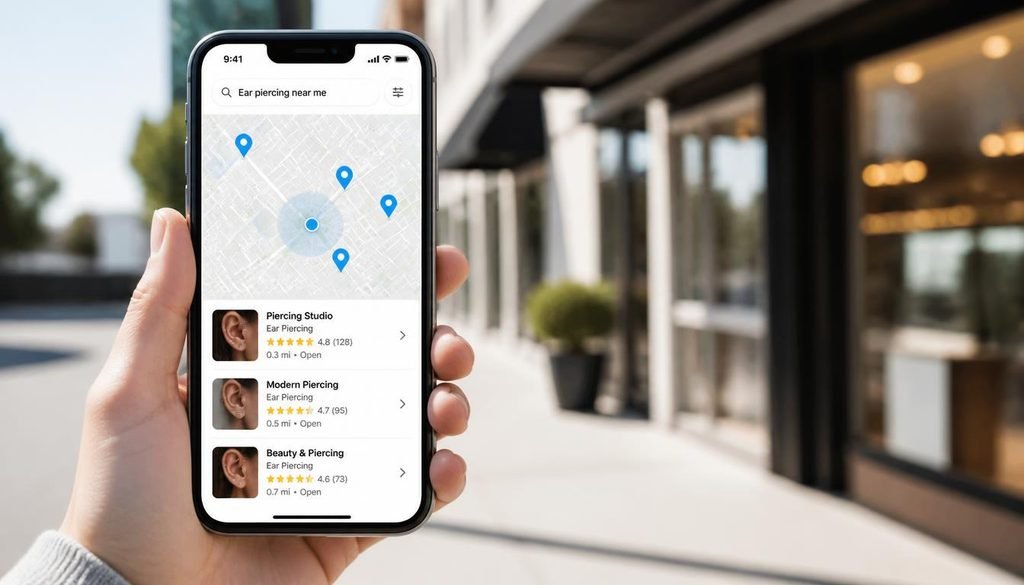
The best way to find ear piercing near you is to compare several local providers instead of choosing the first search result. Google Maps and other local listings can help you create a shortlist, but you should verify important details directly with each provider.
1. Search Google Maps and Local Listings
First, search phrases such as “ear piercing near me,” “professional ear piercing near me,” and “ear piercing studio near me.” Record several nearby providers rather than immediately selecting the highest-rated listing.
2. Compare Recent Reviews
Second, recent reviews are more useful than relying only on an overall star rating. Look for repeated comments about cleanliness, staff professionalism, appointment experiences, jewelry quality, and aftercare.
For example, if several recent customers independently mention clean facilities and helpful aftercare instructions, that pattern can be more informative than one five-star review.
3. Check Services, Hours, and Policies
Third, check whether the provider performs the specific piercing you want. A business offering lobe piercing may not necessarily perform cartilage piercings.
Also verify:
- Opening hours
- Appointment requirements
- Walk-in availability
- Age restrictions
- Parent or guardian requirements
- Identification requirements
- Jewelry options
- Total price
- Aftercare services

4. Contact the Provider Before Visiting
Finally, contact the provider before traveling if important information is unclear online. Ask direct questions about equipment, jewelry, pricing, and the piercing method.
This simple step can prevent surprises when you arrive.
What Should You Look for in a Safe Ear-Piercing Studio?
A safe ear-piercing studio should demonstrate good hygiene, appropriate sterilization, suitable equipment, quality jewelry, and clear aftercare guidance. The Association of Professional Piercers recommends observing the piercing setup and ensuring sterile equipment is used appropriately.
Sterile Equipment and Clean Setup
First, look for a clean and controlled piercing environment. The piercer should wash their hands, use fresh gloves, and handle sterile equipment appropriately.
The APP states that an autoclave uses steam under pressure to sterilize jewelry and other equipment used for piercing.
For example, sterile packages should be opened appropriately for the procedure rather than using equipment whose preparation you cannot verify.
Appropriate Jewelry
Second, new piercings require jewelry selected for safety and proper fit, not simply jewelry chosen because it looks attractive.
Ask about the jewelry’s material, size, design, and suitability for a fresh piercing. The APP emphasizes that initial jewelry should be appropriately sized and made from materials suitable for healing.
Clear Aftercare Instructions
Third, a professional provider should explain what to do during healing. The APP recommends sterile saline wound wash and advises against unnecessary rotation or twisting of jewelry.
Complete ear-piercing aftercare guide
What Are the Different Types of Ear Piercings?
Common ear-piercing types include lobe, upper lobe, helix, forward helix, tragus, conch, rook, and daith piercings. The correct placement depends partly on your individual ear anatomy.
| Piercing | Location | General healing consideration |
|---|---|---|
| Earlobe | Soft lower ear | Usually heals faster |
| Upper lobe | Higher soft lobe | Similar considerations to lobe |
| Helix | Upper outer cartilage | Longer healing |
| Forward helix | Front upper cartilage | Longer healing |
| Tragus | Small cartilage flap | Longer healing |
| Conch | Central ear cartilage | Longer healing |
| Rook | Inner upper cartilage fold | Longer healing |
| Daith | Inner cartilage fold | Longer healing |
Lobe Piercing
Lobe piercing is a piercing through the soft lower portion of the ear and is generally one of the simpler ear piercings. Cleveland Clinic reports that earlobe piercings typically heal in about six to eight weeks.
[Internal link: **“ear piercing healing time” → suggested target page/topic: Ear-piercing healing timeline]
Cartilage Piercings
Cartilage piercings generally take longer to heal than earlobe piercings because cartilage has less blood supply than soft tissue. Cleveland Clinic reports that cartilage piercings such as helix, tragus, conch, rook, and daith piercings may take six to 12 months to fully heal.
How Much Does Ear Piercing Cost Near You?
The cost of ear piercing varies by location, piercing type, jewelry material, and what services are included in the provider’s price. A basic advertised price may not represent the final amount you pay if jewelry or aftercare products are charged separately.
For example, one provider may advertise a low piercing fee while charging separately for jewelry, whereas another may offer a higher package price that includes the jewelry.
Before booking, ask for the complete price, including:
- Piercing fee
- Initial jewelry
- Jewelry upgrades
- Aftercare products
- Consultation fees, if any
- Taxes or other applicable charges
The phrase “cheap ear piercing near me” can help you find budget options, but price should not be your only selection criterion. Very low pricing is not useful if important safety or jewelry information is unclear.
Is Ear Piercing Painful?
Ear piercing usually causes a brief pinch or sharp sensation, but the amount of pain varies according to the piercing location, method, and individual pain tolerance. Cleveland Clinic notes that earlobe piercings generally hurt less than cartilage piercings because the earlobe contains soft tissue while cartilage is thicker.
For example, an earlobe piercing may feel like a quick pinch followed by temporary tenderness, while a cartilage piercing may remain sensitive for longer.
That being said, pain should never be the only factor used to choose a piercing method or provider. Hygiene, sterile equipment, appropriate technique, and proper jewelry remain essential considerations.
Ear-piercing pain and healing guide
How Long Does an Ear Piercing Take to Heal?
Ear-piercing healing time depends heavily on the piercing location, with earlobes generally healing faster than cartilage. Cleveland Clinic reports approximately six to eight weeks for earlobes and potentially six to 12 months for several cartilage piercings.
For example, a helix piercing should not be treated like a fully healed lobe simply because the outside looks normal.
Moreover, a piercing can appear healed before the internal tissue has completely healed. The Association of Professional Piercers explains that piercing wounds heal from the outside inward, so continued care is important throughout the healing period.
What Jewelry Is Best for a New Ear Piercing?
The best jewelry for a new ear piercing is appropriately sized, properly fitted, and made from a material suitable for a healing piercing. Jewelry should be selected with both safety and anatomy in mind rather than appearance alone.
For example, a professional piercer can help determine whether the post length and jewelry style provide enough room for normal swelling without creating unnecessary pressure.
Also, do not assume every decorative earring is appropriate for a fresh piercing. Ask the provider what material they use for initial jewelry and why it is suitable for healing.

What Should You Ask Before Booking an Ear-Piercing Appointment?
Before booking an ear-piercing appointment, ask about sterilization, equipment, jewelry, total price, age requirements, appointment policies, and aftercare. Clear answers can help you identify whether a provider is prepared to meet your needs.
Use this checklist:
- What piercing method do you use?
- How is the equipment sterilized?
- Are needles single-use?
- What jewelry materials do you offer?
- Is jewelry included in the quoted price?
- Do you require an appointment?
- What are your age and parental-consent requirements?
- What identification is required?
- What aftercare instructions do you provide?
- Who should I contact if I have a problem during healing?
Pre-appointment ear-piercing checklist
What Are the Warning Signs of an Unsafe Piercing Studio?
Warning signs of an unsafe piercing studio include poor cleanliness, unclear sterilization procedures, inappropriate equipment, unsuitable jewelry, and pressure to proceed without answering reasonable questions. A professional should be willing to explain the procedure and safety practices.
For example, the APP advises clients to ask to observe the setup and notes that each needle should be used for only one client before being discarded in an appropriate sharps container.
Watch for these red flags:
- Dirty or poorly maintained work areas
- Unclear equipment-sterilization procedures
- Needles that are not clearly single-use
- Pressure to choose a procedure immediately
- No explanation of aftercare
- Unclear total pricing
- Jewelry information that is unavailable
- Staff unwilling to answer safety questions
A reputable provider should make you feel informed rather than pressured.
How Should You Care for a New Ear Piercing?
New ear piercings should be handled gently, kept clean, and cared for according to professional aftercare instructions. The Association of Professional Piercers recommends washing your hands before touching the piercing and using sterile saline wound wash during healing.
For example, the APP advises against twisting or rotating jewelry during cleaning because unnecessary movement can irritate healing tissue.
During healing:
- Wash your hands before touching the area.
- Use appropriate sterile saline as directed.
- Avoid unnecessary touching and jewelry rotation.
- Keep pillowcases and bedding clean.
- Avoid pressure and repeated friction.
- Be careful with headphones, phones, hair, and accessories.
- Follow the professional’s aftercare instructions.
The APP also advises avoiding harsh products such as alcohol and hydrogen peroxide because they can damage cells and interfere with healing.
New-piercing cleaning instructions
Concerning piercing symptoms and when to seek medical care

How Can You Compare Nearby Ear-Piercing Providers?
You can compare nearby ear-piercing providers by evaluating safety, reviews, services, pricing, jewelry, policies, and convenience together. A simple comparison table can prevent you from choosing based on distance or star rating alone.
Before-You-Book Checklist
| Factor | What to check |
|---|---|
| Location | Distance and transportation |
| Reviews | Recent experiences and recurring comments |
| Hygiene | Clean workspace and visible safety practices |
| Equipment | Appropriate sterile or single-use equipment |
| Jewelry | Material, size, quality, and fit |
| Price | Complete cost rather than starting price |
| Policies | Age, ID, consent, and appointments |
| Aftercare | Clear written or verbal instructions |
| Experience | Relevant piercing experience |
| Convenience | Hours and appointment availability |
What Should You Do Before an Ear-Piercing Appointment?
Before an ear-piercing appointment, confirm the provider’s policies, choose suitable jewelry, and understand the expected procedure and aftercare. Preparation makes the appointment more predictable and gives you an opportunity to resolve questions beforehand.
First, confirm the appointment time and required identification or parental consent. Second, ask about the total cost and available initial jewelry. Third, tell the piercer about any previous ear procedures or concerns that could affect placement.
For parents searching for ear piercing for kids near me, age policies are especially important because requirements vary by provider and jurisdiction.
Moreover, if you are considering a cartilage piercing, understand that healing may take considerably longer than a lobe piercing. Cleveland Clinic notes that several cartilage piercings can take six to 12 months to fully heal.
What’s Next After Finding Ear Piercing Near You?
After finding a suitable ear-piercing provider, the next step is to verify the details directly and make an informed appointment decision. Do not assume that an online listing contains every current policy or price.
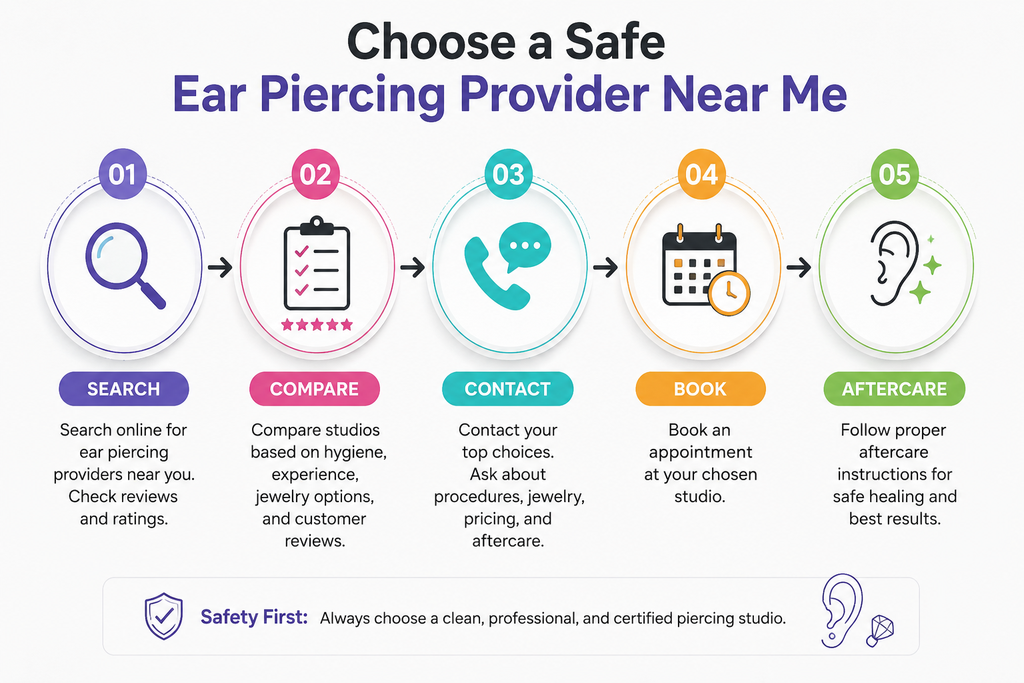
Use this simple process:
- Shortlist three nearby providers.
- Read recent reviews and examine their service information.
- Check hygiene and sterilization practices.
- Ask about jewelry and total pricing.
- Confirm age, identification, and appointment requirements.
- Ask what aftercare instructions you will receive.
- Choose the provider that offers the best overall combination of safety, professionalism, suitability, and convenience.
This approach works whether you are searching for lobe piercing near me, cartilage piercing near me, or professional ear piercing near me.
Conclusion
The best ear piercing near me is not necessarily the closest or cheapest option; it is the provider that combines convenience with appropriate hygiene, professional practices, suitable jewelry, transparent pricing, and clear aftercare. Local search results can help you find potential providers, but careful comparison helps you make a better decision.
Ultimately, take a few extra minutes to check recent reviews, ask safety questions, confirm the total price, and understand the healing process. A little preparation can make your ear-piercing experience more comfortable, informed, and predictable.
Choose carefully, ask questions, and prioritize safety over distance or price.
Written by myserioi.com Editorial Team — Health and wellness content team
Reviewed by Editorial Review Team — Health and wellness content review
Disclaimer: This article was initially drafted using AI assistance. However, the content has undergone thorough revisions, editing, and fact-checking by human editors and subject matter experts to ensure accuracy. Information about piercing safety and aftercare is educational and should not replace advice from a qualified healthcare professional or experienced professional piercer.