

Table of Contents
You’ve probably come across sentences that look straightforward but seem to suggest something beyond the words themselves. The difficult part is figuring out what the speaker or writer is really trying to communicate. In this guide, you’ll learn what implicit sentences are and see five simple examples, along with the meaning each one can suggest.
Key Takeaways
- Implicit sentences communicate ideas indirectly instead of stating the intended message in a direct way.
- Context helps readers understand implicit meaning by providing clues about what the speaker or writer intends.
- Everyday statements can contain implied requests, feelings, opinions, or suggestions.
- Five simple examples can help students recognize implicit meaning in conversations and writing.
- Explicit sentences state meaning directly, while implicit sentences leave part of the meaning for the reader to infer.
- Students can identify implicit meaning by considering the situation, speaker, wording, and unstated message.
- Creating and explaining your own examples is a practical way to build confidence with implicit meaning.
What Is an Implicit Sentence?
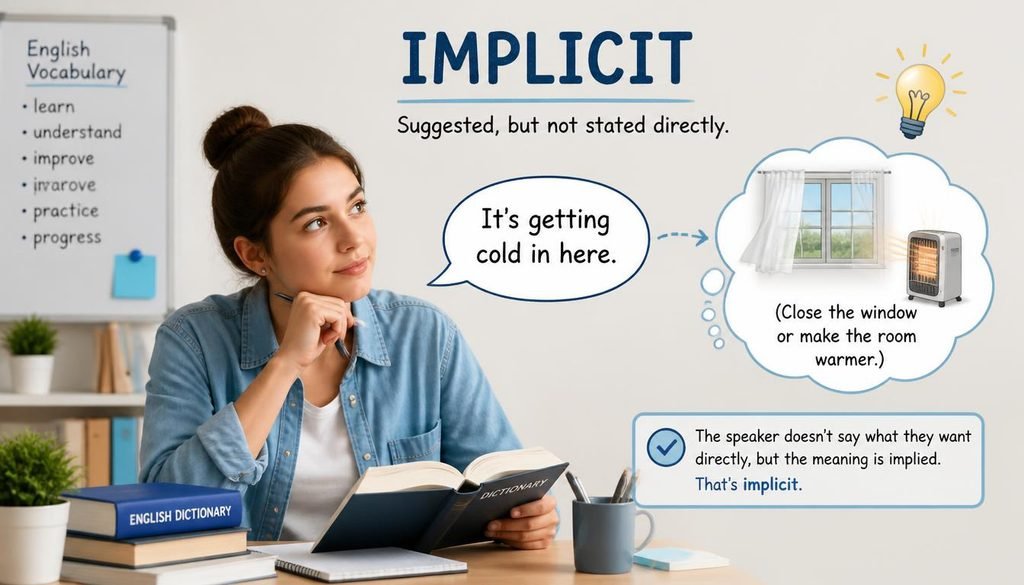
An implicit sentence communicates an idea indirectly, so the reader or listener uses context to understand the intended meaning. In simple terms, something implicit is suggested rather than said openly.
An implicit sentence does not necessarily make its meaning difficult to understand. Instead, it gives the reader or listener enough information to work out what the speaker may actually mean.
For example, consider this sentence:
“I haven’t eaten since breakfast.”
The speaker does not actually say, “I am hungry.” Even so, the listener can reasonably understand that the speaker is probably hungry. That suggested idea is the implicit meaning.
What Does Implicit Meaning Mean in a Sentence?
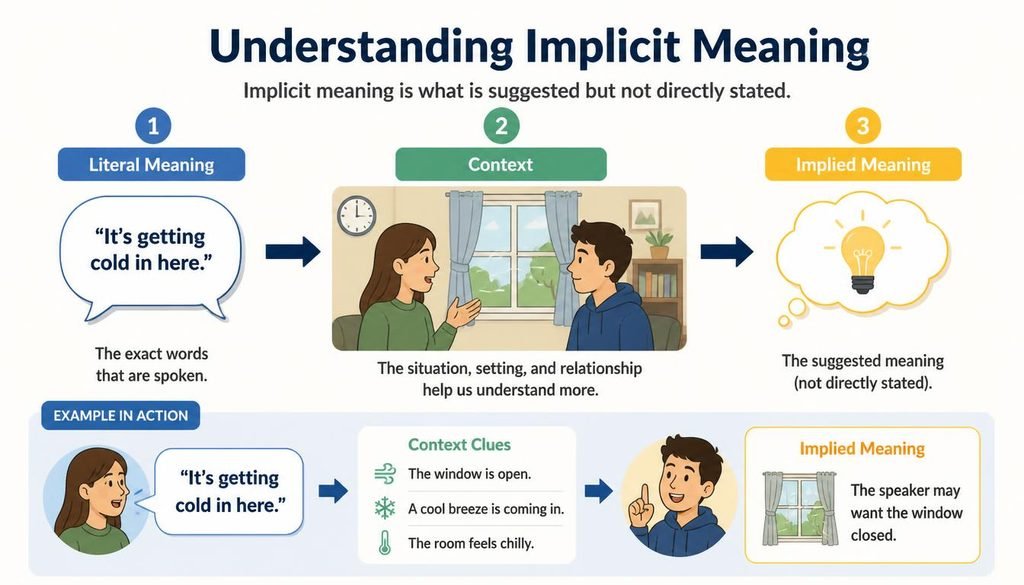
Implicit meaning is the message or idea that a sentence suggests without stating it directly. The listener often needs to use the surrounding situation and their understanding of the conversation to work out that message.
For example, someone might say, “It is very dark in this room.” The direct meaning is that the room does not have much light. In the right situation, however, the speaker may also be suggesting that someone should turn on a light.
This means literal meaning and implied meaning are not always the same. Literal meaning comes directly from the words, while implied meaning comes from what the listener understands from the words and context.
Why Is Understanding Implicit Meaning Important?
Understanding implicit meaning is important because people often express suggestions, feelings, opinions, and requests without saying them directly. Students encounter this kind of communication when reading stories, answering comprehension questions, and following everyday conversations.
Implicit meaning is also part of reading between the lines. A reader may need to combine the sentence with details about the situation before understanding what the writer or speaker intends.
For example, imagine a character entering a room filled with dirty dishes and saying, “Wow, someone has been very busy today.” The character does not directly ask anyone to clean the dishes, but the situation may make the comment sound like criticism.
Students who can recognize implied meaning can understand more than the exact words written on the page.
What Are 5 Examples of Implicit Sentences?
Here are five simple implicit sentence examples, along with the message each sentence may suggest in the right context.
| # | Implicit Sentence | Possible Implied Meaning |
|---|---|---|
| 1 | “It’s getting cold in here.” | Please close the window or turn up the heat. |
| 2 | “Your room is certainly interesting.” | Your room may be messy or unusual. |
| 3 | “Some people clean their rooms every day.” | You should probably clean your room. |
| 4 | “I haven’t eaten since breakfast.” | I am probably hungry. |
| 5 | “The trash can is completely full.” | Someone should take out the trash. |
1. “It’s Getting Cold in Here.”
The sentence itself only describes the temperature. However, the speaker may be using that observation as an indirect request.
For example, if a window is open on a cold day and someone says, “It’s getting cold in here,” the listener may understand the unstated request: close the window.
The speaker never says, “Please close the window.” Instead, the listener uses the situation to understand the implied message.
2. “Your Room Is Certainly Interesting.”
The word interesting does not automatically mean messy. The intended meaning depends on the speaker’s tone, the situation, and what the room actually looks like.
For example, if a parent sees clothes, books, and toys scattered across the floor and says, “Your room is certainly interesting,” the comment may indirectly criticize the room’s condition.
The same sentence could have a completely different meaning in another situation. If the room contains unusual artwork or creative decorations, interesting could be a genuine compliment.
3. “Some People Clean Their Rooms Every Day.”
The sentence sounds like a simple observation about other people. It does not directly tell anyone to pick up their clothes or organize their room.
For example, if a parent says this while looking at a teenager’s messy bedroom, the implied message could be, “You should clean your room.”
The sentence is implicit because the request is suggested instead of stated directly.
4. “I Haven’t Eaten Since Breakfast.”
“I haven’t eaten since breakfast” can implicitly mean that the speaker is hungry.
Imagine two friends deciding what to do after school. One friend says, “I haven’t eaten since breakfast.” The speaker may be hinting that they want to get something to eat.
The sentence does not directly say, “I am hungry” or “Let’s get food.” The listener makes that connection from the circumstances.
This example shows how implicit meaning can communicate a feeling or need without naming it directly.
5. “The Trash Can Is Completely Full.”
“The trash can is completely full” can implicitly suggest that someone should take out the trash.
The direct information is simply that the trash can has reached its capacity. In a household setting, though, the speaker may be indirectly asking another person to empty it.
For example, a family member standing beside a full trash can might say, “The trash can is completely full.” The listener may understand that they are being asked to take the trash outside.
This type of indirect statement is common because people often expect others to understand simple requests from the situation.
How Do You Identify an Implicit Sentence?
You can identify an implicit sentence by looking for context, unstated suggestions, speaker intention, and information that the reader must infer.
Start by asking what the sentence says on its own. Then consider what the speaker might want the listener to understand beyond those exact words.
A simple way to identify implicit meaning is:
- Read the sentence carefully.
- Find its literal meaning.
- Consider the surrounding situation.
- Think about the speaker’s likely intention.
- Look for the unstated message.
- Check whether your interpretation fits the context.
For example, consider “The lights are still on.” The literal meaning is that the lights have not been switched off. If everyone is preparing to leave the house, the implied message could be, “Please turn off the lights.”
How Can Context Help You Understand Implicit Meaning?
Context helps you understand implicit meaning because one sentence can suggest different things in different situations.
For example, “That’s a big bag” can simply describe the size of a bag. If someone is struggling to carry that bag, however, the same comment could suggest that the bag is heavy or that the person may need help.
That is why you should not examine an implicit sentence using its words alone. Consider who is speaking, where the conversation takes place, what happened before, and what the speaker may want.
Context matters because an implicit sentence can sometimes support more than one reasonable interpretation.
What Is the Difference Between Implicit and Explicit Sentences?
For example, compare these pairs:
| Implicit | Explicit |
|---|---|
| “I haven’t eaten since breakfast.” | “I am hungry.” |
| “It’s getting cold in here.” | “Please close the window.” |
| “The trash can is completely full.” | “Please take out the trash.” |
| “Some people clean their rooms every day.” | “Please clean your room.” |
The implicit versions communicate the message indirectly. The listener needs to consider the context before deciding what the speaker means.
The explicit versions state the intended message clearly. The listener does not need to make the same inference.
What Is an Example of an Implicit Sentence in Everyday Conversation?
An everyday implicit sentence is “It’s getting late,” which may suggest that it is time to leave or go home.
For example, two friends might be talking at someone’s house. If one friend says, “It’s getting late,” the comment may be more than an observation about the clock. It could be an indirect suggestion that the conversation should end.
The same sentence can have another meaning in a different setting. If someone says it while getting ready for bed, it may simply mean that they are tired or ready to sleep.
How Do You Write an Implicit Sentence?
You can write an implicit sentence by describing a fact or situation that allows the reader to work out the message without stating it directly.
First, decide what you want the reader to understand. Then turn that direct message into an observation that provides enough clues.
For example, suppose you want someone to close a door. An explicit sentence would be:
“Please close the door.”
An implicit version could be:
“There is a strong draft coming through the door.”
The second sentence describes the situation rather than giving a direct command. From that information, the reader may infer that the door should be closed.
A useful formula is:
Observation + Context → Implied Meaning
Can an Implicit Sentence Have More Than One Meaning?
For example, “Your friend is here” could simply be information. In another situation, the same statement could indirectly suggest that you should go and meet your friend.
Likewise, “That was interesting” might show genuine excitement, surprise, mild criticism, or sarcasm depending on the situation and tone.
Students should therefore avoid assuming that every implicit sentence has one fixed hidden meaning. Context and speaker intention usually provide the clues needed to choose the most reasonable interpretation.
What Are Some More Implicit Meaning Examples?
More implicit meaning examples include statements that indirectly communicate requests, feelings, opinions, warnings, or suggestions.
For example:
- “The floor is getting dirty.” → Someone may be suggesting that it should be cleaned.
- “I can’t see the board from here.” → A student may be suggesting that they need a better seat.
- “This bag feels heavy.” → Someone may be indirectly asking for help.
- “There aren’t many seats left.” → Someone may be suggesting that people should sit down.
- “The baby is finally asleep.” → Someone may be indirectly suggesting that others should stay quiet.
These examples show why implicit statements depend heavily on context. Without knowing the situation, a reader may not know which message the speaker intends.
How Can Students Practice Identifying Implicit Meaning?
Students can practice identifying implicit meaning by reading short sentences, finding the literal meaning, and then explaining what the speaker may be suggesting.
Try these examples before checking the possible answers.
Practice 1
“The classroom is very noisy today.”
Possible implied meaning: The students should become quieter.
Practice 2
“I have a test tomorrow, and I haven’t studied yet.”
Possible implied meaning: The speaker needs to study or may want help studying.
Practice 3
“There are dishes all over the kitchen.”
Possible implied meaning: Someone should clean the kitchen or wash the dishes.
Practice 4
“My phone battery is almost dead.”
Possible implied meaning: The speaker may need a charger.
Try to identify the implied meaning before reading each answer. Then compare your interpretation with the possible meaning provided.
Remember that an implicit sentence can have different interpretations when the context changes. Your answer should make sense and be supported by the situation.
What Tools Can Help You Practice Implicit Meaning?
Simple reading and writing activities are useful for practicing implicit meaning, while dictionaries and educational resources can help students understand unfamiliar terms.
Students can use a dictionary such as Cambridge Dictionary to check words including implicit, explicit, and imply. A dictionary can help you understand the basic distinction between something stated directly and something suggested.
Students can also practice with short stories, conversations, and reading-comprehension questions. Educational question-and-answer platforms such as Brainly contain student questions about implicit meaning and can provide additional examples to study.
Creating your own examples is also valuable. Instead of memorizing sentences, write one yourself and explain what the reader is expected to understand from it.
How Do You Write Your Own Implicit Sentence?
You can create your own implicit sentence by taking a direct message and turning it into an observation or indirect statement.
For example, begin with this direct message:
Direct message: Please turn off the fan.
Now change it into an indirect statement:
Implicit sentence: “The fan is making the room really cold.”
The implied message is that the fan should probably be turned off or adjusted.
Try the same process with other situations:
- Choose a direct request or feeling.
- Remove the direct instruction.
- Describe an observation connected to the message.
- Give the reader enough context to infer the meaning.
- Explain the implied meaning.
This method makes implicit meaning easier to understand. The goal is not to make a sentence confusing; it is to communicate an idea indirectly while giving the reader enough clues to understand it.
What Should Students Do Next to Practice Implicit Meaning?
Students should practice implicit meaning by writing five original sentences and explaining the message each sentence suggests.
For example:
- “The window is still open.” → Someone should close it.
- “I have a lot of homework tonight.” → I may not be able to go out.
- “There is no milk left.” → Someone should buy milk.
- “The movie starts in ten minutes.” → We should get ready to leave.
- “My shoes are completely wet.” → I may need another pair of shoes.
After writing the examples, change each implicit sentence into an explicit sentence. This simple exercise makes the difference between implied and directly stated meaning easier to remember.
You can also build a short daily practice routine. Write one implicit sentence and answer these three questions:
- What does the sentence literally say?
- What does the speaker probably mean?
- What context helps me understand that meaning?
Conclusion
Implicit sentences communicate ideas indirectly instead of stating the intended message clearly. The five examples in this guide show how ordinary statements can suggest requests, feelings, suggestions, or opinions.
Context plays an important role in understanding implicit meaning. For example, “I haven’t eaten since breakfast” directly tells us when someone last ate, but it can also suggest that the speaker is hungry.
The best way to become comfortable with implicit meaning is to practice. Read the sentence, identify its literal meaning, consider the context, and then explain what the speaker may actually intend.
Once you become familiar with these clues, implicit meaning becomes easier to recognize in English conversations, stories, reading passages, and school assignments.
Written by: myserioi.com Editorial Team — Educational content team focused on clear, beginner-friendly English learning resources.
Reviewed by: English Content Reviewer — Reviewer focused on definitions, examples, and explanations for clarity and educational accuracy.
Disclaimer: This article was initially drafted using AI assistance. However, the content has undergone thorough revisions, editing, and fact-checking by human editors and subject matter experts to ensure accuracy.
Affiliate Disclosure
Some links on this website may be affiliate links. This means that if you click a link and make a purchase, we may receive a small commission at no additional cost to you.
We only recommend products, services, or resources that we believe may be useful to our readers. Our recommendations do not affect the price you pay.