
Table of Contents
The Ultimate Guide: How to Build Confidence in Shy Children Without Pressure
Many parents notice that their shy child becomes quiet around new people, avoids speaking up, or needs extra time to feel comfortable in unfamiliar situations. However, what may be missing is not pressure to “come out of their shell,” but small experiences that help the child feel capable and safe. In this guide, you’ll learn practical ways to build confidence in shy children while respecting their personality, developmental stage, and individual pace.
Key Takeaways
- Childhood shyness is common and does not automatically mean a child has low confidence or a social problem.
- Small, achievable challenges can help shy children develop confidence without overwhelming them.
- Specific praise helps children recognize the behaviors and efforts that demonstrate confidence.
- Gradual social practice can help children become more comfortable with conversations, new people, activities, and unfamiliar situations.
- Positive parenting support includes patience, preparation, encouragement, modeling, and avoiding comparisons or public labels.
- Confidence-building activities can use hobbies, role-play, storytelling, responsibilities, and structured social opportunities.
- Professional guidance may be appropriate when shyness consistently interferes with school, friendships, everyday activities, or a child’s well-being.
What Is Shyness in Children and How Does It Affect Them?
Childhood shyness is a tendency to feel hesitant, quiet, or uncomfortable in unfamiliar social situations, and it does not automatically mean a child lacks confidence. A shy child may take longer to warm up, avoid being the center of attention, speak softly, or stay close to a familiar adult when meeting new people.
Moreover, shyness can look different at different ages. A preschooler may hide behind a parent when visitors arrive, while a school-age child may know the answer in class but hesitate to raise a hand. The behavior itself does not necessarily indicate a problem.
For example, the CDC notes that social and communication abilities develop across childhood, and its milestone resources are designed to help families monitor how children play, learn, speak, and interact. (CDC)
Is Shyness the Same as Low Confidence?
Shyness and low confidence are related but different concepts. A child can be quiet in groups while feeling confident about their abilities, interests, or relationships.
For example, a child might confidently build a complicated LEGO model but become uncomfortable when asked to explain it to a group. In this situation, the child may need more practice with public communication rather than a general increase in self-worth.
Furthermore, it is useful to avoid describing a child as “the shy one.” Repeated labels can make a temporary behavior feel like a permanent identity.
When Is Shyness Usually Normal?
Normal shyness generally becomes less concerning when a child can participate in everyday life after receiving reasonable time, support, and familiarity. Some children naturally need longer warm-up periods before joining conversations or activities.
For example, a child may watch other children play for ten minutes before eventually joining them. That gradual approach can simply reflect temperament rather than a serious social difficulty.
At the same time, developmental expectations vary by age. The CDC emphasizes that developmental milestones represent skills most children—at least 75%—can do by a particular age, rather than rigid requirements for every child. (CDC)
Why Is Building Confidence Important for Shy Children?
Building confidence helps shy children approach communication, friendships, learning, and unfamiliar experiences with greater willingness and independence. Confidence does not mean becoming loud or highly outgoing; it means developing a belief that trying, communicating, and making mistakes are manageable.
First, confidence can support communication skills because children are more likely to express questions, preferences, and needs when they feel safe. For example, a child who practices asking a teacher for help at home may find the real situation less intimidating.
Second, confidence can support friendships because social relationships require repeated attempts to approach, communicate, listen, cooperate, and recover from awkward moments.
How Does Confidence Help at School?
Social confidence can help children participate more comfortably in classroom and school activities. A confident child does not need to answer every question or volunteer for every activity; the important goal is having enough confidence to participate when appropriate.
For example, a child who normally avoids group activities might begin by reading one sentence during a small-group exercise rather than giving a presentation to the entire class.
Moreover, confidence can support independence. When children experience manageable successes, they learn that they can handle tasks without always relying on an adult.
Does a Shy Child Need to Become Outgoing?
A shy child does not need to become outgoing to become confident. The goal is to help the child feel secure enough to communicate, participate, make choices, and handle unfamiliar situations at their own pace.
For example, success might mean saying “hello” to one new child rather than becoming the most talkative person at a party.
That distinction matters because healthy confidence is about capability and comfort, not personality transformation.
How Can Parents Build Confidence in a Shy Child?
Building confidence in shy children involves giving them supportive opportunities to practice skills, experience small successes, and gradually become comfortable with challenging situations. The following steps can be introduced slowly rather than all at once.
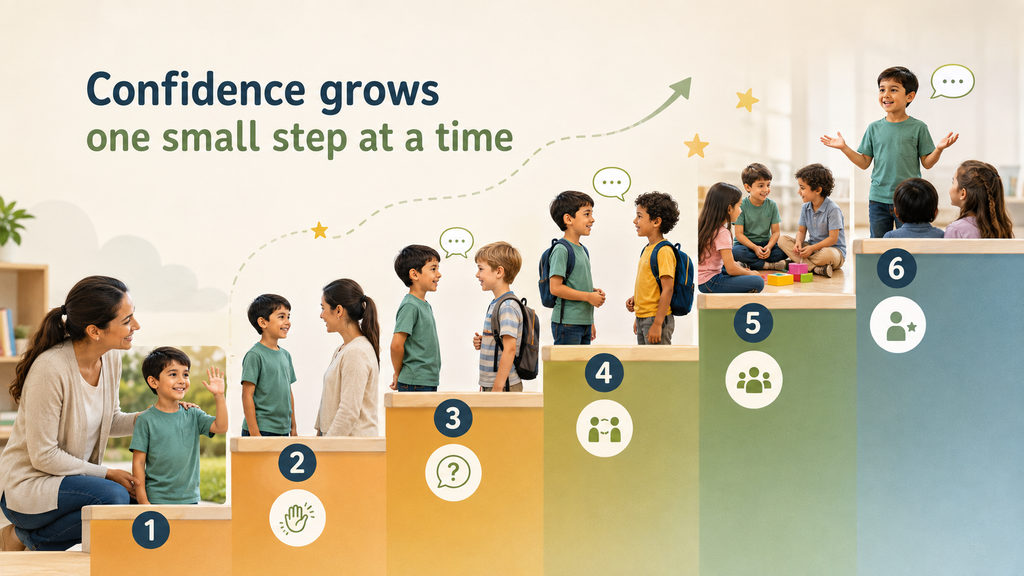
1. Start With Small Achievable Goals
Small goals give shy children opportunities to experience success without overwhelming them. Instead of asking a child to speak in front of an entire class, begin with a task that is only slightly outside their comfort zone.
For example, use a progression such as:
- Say hello to a familiar adult.
- Ask one simple question.
- Talk with one familiar child.
- Join a small group.
- Participate in a larger activity.
Moreover, celebrate completion rather than demanding perfection. A child who says two words to a new friend has still practiced an important social skill.
2. Give Specific Praise
Specific praise helps children recognize the behaviors and efforts that demonstrate confidence rather than treating confidence as a fixed personality trait.
Instead of saying, “You’re such a confident child,” try saying, “You looked nervous, but you still introduced yourself.” This tells the child exactly what they did successfully.
For example, praise can focus on effort, preparation, persistence, communication, and problem-solving.
3. Give Preparation Time
Preparation can make unfamiliar social situations feel more predictable for a shy child. Before attending a birthday party, explain what will probably happen and practice one or two simple phrases.
For example, you might rehearse: “Hi, my name is Sam. Can I play too?”
Additionally, role-play can help children practice without the immediate pressure of a real social situation. The CDC specifically recommends preparing young children for new places and people through stories and pretend play. (CDC)
4. Introduce New Experiences Gradually
Gradual exposure allows children to become familiar with challenging situations in manageable steps. If a crowded party feels overwhelming, begin with a short visit to a quieter playdate.
For example, a child might first visit a new activity with a parent, then observe from the side, then participate for five minutes, and eventually attend independently.
The goal is not to eliminate every uncomfortable feeling. The goal is to help the child discover, “I can handle this.”
Phytomem One for Adult Brain Support
For adults who are also interested in supporting memory, focus, and mental clarity as part of a healthy lifestyle, Phytomem One is a dietary supplement formulated with a blend of botanical and other ingredients. It is marketed as a once-daily brain-support formula for adults, rather than as a treatment for shyness, anxiety, or childhood confidence.

How Can You Help a Shy Child Make Friends?
A shy child can make friends more easily when social opportunities are structured, predictable, and based on shared interests. Large, unstructured groups can be difficult for children who need more time to warm up.
Start With One Child
One-on-one interactions are often less demanding than large-group social situations. Invite one compatible child for a short playdate rather than arranging a large gathering.
For example, two children who both enjoy drawing can spend 30 minutes creating pictures together. A shared activity gives them something to talk about naturally.
Use Shared Interests
Shared interests create natural conversation starters for shy children. Children may find it easier to communicate when the conversation is connected to something they already enjoy.
For example, a child who loves dinosaurs might ask another child, “What’s your favorite dinosaur?” A child who likes football might begin by discussing a favorite team or game.
Practice Simple Introductions
Role-playing introductions can give shy children a ready-made social script. Practice saying a name, asking a simple question, and responding to another person’s answer.
A basic script could be:
“Hi, I’m Maya.”
“What are you playing?”
“Can I play with you?”
Moreover, teach children that conversations do not need to be perfect. A pause, mistake, or awkward moment is a normal part of social interaction.
How Can Parents Encourage a Shy Child to Speak Up?
Parents can encourage a shy child to speak up by allowing response time, modeling communication, and offering manageable opportunities to answer independently. Encouragement works better when it does not turn every conversation into a test.
Give Enough Time to Respond
Extra response time can help a hesitant child organize thoughts before speaking. Instead of immediately answering for the child, wait calmly for their response.
For example, if a relative asks, “What did you do at school?”, give the child a few moments before answering on their behalf.
Avoid Speaking for Them Every Time
Parents should avoid automatically answering every question for a shy child because children need opportunities to practice communication themselves. Support is useful, but constant substitution can remove valuable practice.
For example, instead of saying, “She doesn’t want juice,” you might quietly encourage the child to say, “No, thank you.”
Model Calm Communication
Children can learn communication habits by observing how adults greet people, ask questions, handle mistakes, and disagree respectfully. You do not need to give a formal lesson every time.
For example, let your child hear you say, “I’m not sure, but I’ll ask,” when you do not know an answer. This models the idea that uncertainty does not have to prevent communication.
Should You Force a Shy Child to Socialize?
Parents generally should not force a shy child into overwhelming social situations as a way to make the child confident. Pressure, teasing, public attention, and forced performance can increase distress rather than teach useful skills.
For example, telling a quiet child, “Go say hello right now or you’re being rude,” may make future introductions feel even more threatening.
Instead, use gentle encouragement plus gradual participation. A parent might say, “You don’t have to talk right away. Let’s stand here together, and when you’re ready, you can say hello.”
What Should Parents Avoid When Helping a Shy Child?
Parents should avoid comparisons, teasing, public labels, excessive criticism, and unrealistic demands when supporting a shy child.
| Avoid | Try Instead |
|---|---|
| “Why can’t you be confident like your brother?” | “Let’s practice one small step.” |
| “She’s very shy.” in front of others | “She likes a little time to warm up.” |
| Forcing a child to perform | Offering gradual participation |
| Praising only winning or speaking | Praising effort and persistence |
| Answering every question for the child | Giving reasonable response time |
| Comparing the child with classmates | Tracking the child’s own progress |
Moreover, positive parenting is part of healthy child development. The CDC identifies safe, loving relationships and activities such as talking, reading, playing, and spending time together as important supports for children’s development. (CDC)
What Are the Best Confidence-Building Activities for Shy Children?
Confidence-building activities for shy children work best when they provide repeated practice, achievable challenges, and opportunities for children to use their existing strengths.
Role-Playing
Role-playing lets children rehearse social situations before experiencing them in real life. Parents can pretend to be a teacher, new friend, shopkeeper, coach, or unfamiliar adult.
For example, practice ordering a snack, introducing yourself, asking for help, or joining a game.

Storytelling and Drawing
Storytelling and drawing can help children express feelings and practice communication without immediate social pressure. Ask the child to create a character who feels nervous about meeting someone new.
For example, ask, “What could the character do when they feel nervous?” This can encourage problem-solving while keeping the discussion indirect and comfortable.
Hobby-Based Activities
Hobbies give shy children a natural setting to develop competence and connect with others. Art, music, sports, coding, gardening, reading, or building projects can create shared experiences.
For example, a child who loves drawing might feel more comfortable joining an art class than an unstructured social gathering.
Age-Appropriate Responsibilities
Small responsibilities help children experience competence and independence. Give children tasks that are challenging but realistic for their age.
For example, a younger child might set napkins on the table, while an older child might order their own food at a familiar restaurant.
The CDC includes age-appropriate helping and household responsibilities among examples of social-emotional development in young children. (CDC)
Simple Conversation Games
Conversation games turn social practice into a low-pressure activity. Try questions such as:
- “What was your favorite part of today?”
- “If you could learn one new skill, what would it be?”
- “What game should we play?”
- “What is something you are proud of?”
Phytomem One for Adult Brain Support
For adults who are also interested in supporting memory, focus, and mental clarity as part of a healthy lifestyle, Phytomem One is a dietary supplement formulated with a blend of botanical and other ingredients. It is marketed as a once-daily brain-support formula for adults, rather than as a treatment for shyness, anxiety, or childhood confidence.

How Can Role-Playing Help a Shy Child Become More Confident?
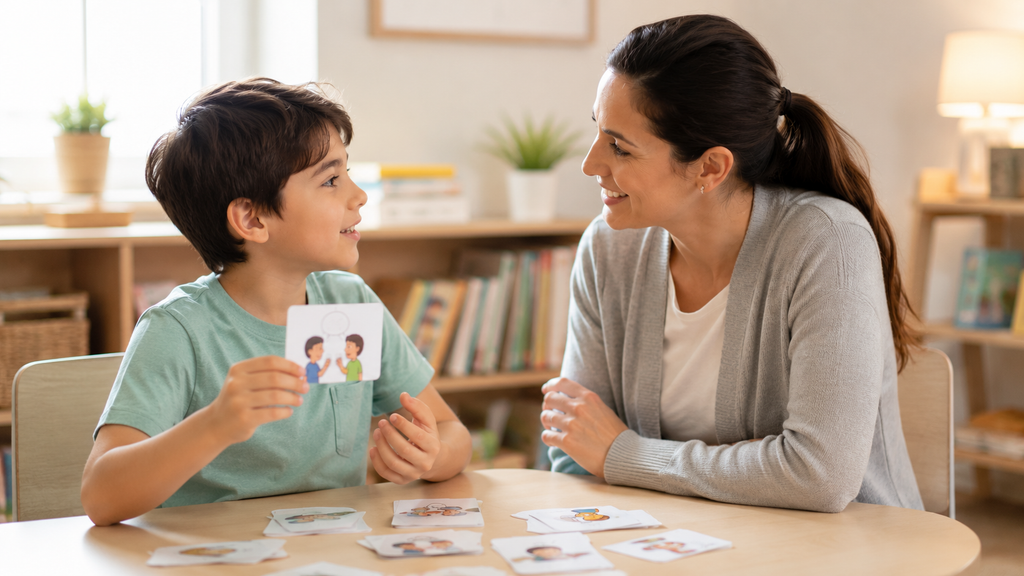
Role-playing helps shy children practice social behaviors in a predictable environment before using those behaviors in real situations. It allows parents to repeat the same skill without making mistakes feel embarrassing.
For example, take turns pretending to meet someone new. First, the parent acts as the child while the child watches. Next, switch roles and let the child practice.
Then gradually increase the challenge:
- Say hello.
- Introduce yourself.
- Ask one question.
- Respond to an answer.
- Join a simple activity.
- End the conversation politely.
Moreover, the CDC recommends pretend play and role-playing as ways to help young children prepare for new places and people. (CDC)
What Are Practical Tools Parents Can Use to Build Social Confidence?
The most useful tools for building confidence are simple routines, conversation scripts, progress trackers, role-play prompts, and age-appropriate developmental resources. Parents do not need expensive products to practice these skills.
Create a Confidence Ladder
A confidence ladder ranks social situations from easiest to hardest so a child can practice gradually. Write five to seven situations on paper and start with the least intimidating one.
For example:
| Level | Practice |
|---|---|
| 1 | Smile and wave at a familiar person |
| 2 | Say “hello” |
| 3 | Ask one question |
| 4 | Talk with one new child |
| 5 | Join a small group |
| 6 | Speak briefly in class |
| 7 | Participate in a larger presentation |
Track Effort, Not Perfection
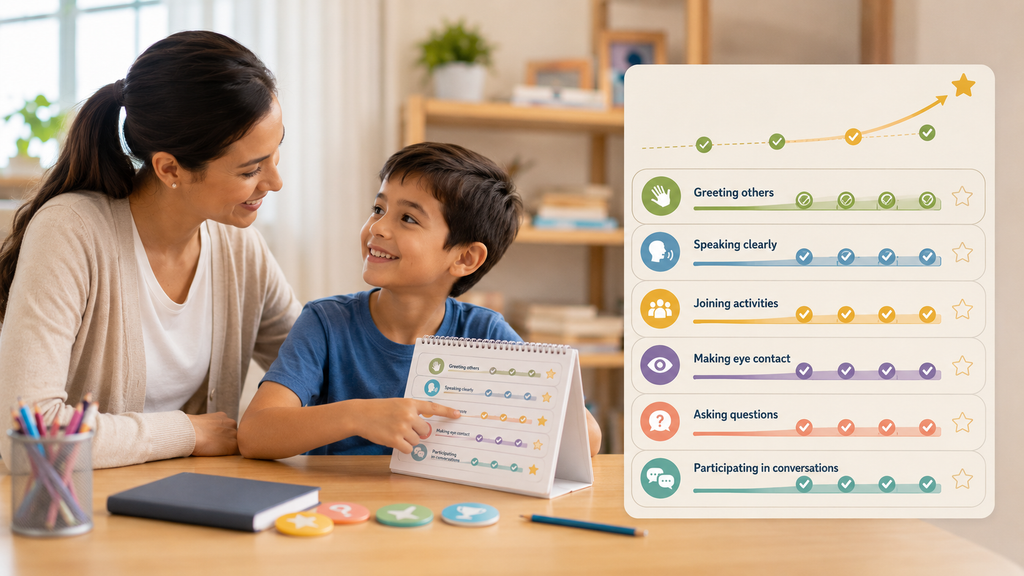
A simple weekly tracker can help children see their own progress. Record what they attempted rather than whether the interaction was perfectly successful.
For example, write “Asked a new friend a question” instead of “Made a new friend.” The first outcome is within the child’s control.
Parents can also use the CDC’s developmental milestone resources to support conversations with healthcare professionals when developmental concerns arise. CDC emphasizes that milestone checklists are communication tools and are not substitutes for standardized developmental screening. (CDC)
When Does Shyness Become a Concern for a Child?
Shyness becomes more concerning when persistent fear, avoidance, or distress significantly interferes with a child’s school participation, friendships, everyday activities, or emotional well-being. The level of interference matters more than simply whether a child describes themselves as shy.
For example, occasional hesitation before joining a party is different from repeatedly refusing school because of intense fear of interacting with classmates.
What Signs Should Parents Watch For?
Parents should pay attention when social fear consistently produces substantial avoidance or distress. Possible warning signs include:
- Regularly avoiding school or social activities.
- Persistent difficulty making or maintaining friendships.
- Strong fear of being judged or embarrassed.
- Physical symptoms such as shaking, sweating, nausea, or a racing heart during social situations.
- Frequent refusal to speak or participate.
- Significant distress before ordinary social activities.
NIMH notes that social anxiety can involve fear of being judged, avoidance of social situations, physical symptoms, and difficulty participating in everyday activities; in children, it can also involve school avoidance, friendship difficulties, stomachaches, emotional outbursts, or refusal to speak. (National Institute of Mental Health)
Child Mind Institute similarly explains that social anxiety in children involves anxiety severe enough to interfere with daily life, while selective mutism involves an anxiety-related inability to speak in certain situations. (Child Mind Institute)
When Should Parents Seek Professional Help for a Shy Child?
Parents should consider professional guidance when shyness or social fear persists and substantially affects daily functioning or well-being. A pediatrician, child psychologist, or other qualified mental-health professional can help determine whether the behavior reflects temperament, anxiety, communication difficulties, or another concern.
For example, if a child repeatedly wants to speak at school but appears unable to do so because of intense anxiety, discussing the pattern with a professional is appropriate.
NIMH explains that social anxiety disorder is characterized by significant fear or anxiety and avoidance or extreme discomfort that interferes with daily life; evidence-based treatment can include psychotherapy such as cognitive behavioral therapy. (National Institute of Mental Health)
What Is a Simple 7-Day Confidence Plan for a Shy Child?
A seven-day confidence plan uses one small, manageable social or independence activity each day rather than expecting a dramatic personality change. Parents can repeat the week or adjust the difficulty according to the child’s age and comfort.
Day 1: Practice a Greeting
Day one focuses on one simple greeting. Practice saying “hello” or waving to a familiar person.
For example, rehearse the greeting three times at home and use it once outside.
Day 2: Practice a Question
Day two focuses on asking one simple question. Use a familiar situation such as asking a parent, teacher, or friend about an activity.
For example: “What are you playing?”
Day 3: Use a Hobby
Day three connects social interaction with an activity the child already enjoys. Spend time drawing, building, reading, playing a sport, or doing another preferred activity with someone else.
Day 4: Try a Short Social Interaction
Day four introduces a brief interaction with one familiar or friendly person. Keep the situation short and predictable.
For example, encourage the child to speak with a cousin for five minutes.
Day 5: Practice a New Situation
Day five introduces a mildly unfamiliar situation with preparation. Explain what will happen before arriving and rehearse one useful phrase.
[Internal link: **“healthy routines for children” → suggested target page/topic: Children’s daily-routine guide]
Day 6: Give the Child a Responsibility
Day six builds confidence through independence rather than social performance. Ask the child to complete a realistic task independently.
For example, let them choose an activity, order a familiar item, or help prepare something at home.
Day 7: Reflect and Celebrate Progress
Day seven focuses on reflection and specific praise. Ask what felt easy, what felt difficult, and what the child would like to practice next.
For example, say, “You were nervous about saying hello, but you tried anyway. What should we practice next?”
The purpose of the seven-day plan is practice, not perfection. A child who completes only two or three activities has still gained valuable experience.
What’s Next: How Can Parents Continue Building Confidence?
The next step is to repeat small confidence-building experiences while gradually increasing challenge only when the child is ready. Confidence usually develops through repeated experiences rather than through one major breakthrough.
First, choose one social skill to practice for the next week. Greeting, asking questions, joining games, or speaking to a teacher can each become a separate goal.
Second, keep expectations realistic. A child may progress quickly in one setting but need more time in another.
Third, coordinate with teachers when school participation is difficult. A teacher may be able to provide a smaller speaking opportunity, pair the child with a supportive peer, or give advance notice about presentations.
Finally, keep building competence outside social situations. Hobbies, household responsibilities, creative activities, physical activity, and problem-solving experiences can all reinforce the message that the child is capable.
Phytomem One for Adult Brain Support
For adults who are also interested in supporting memory, focus, and mental clarity as part of a healthy lifestyle, Phytomem One is a dietary supplement formulated with a blend of botanical and other ingredients. It is marketed as a once-daily brain-support formula for adults, rather than as a treatment for shyness, anxiety, or childhood confidence.

Conclusion
Confidence in shy children grows through safety, encouragement, competence, and gradual participation rather than pressure to become outgoing. Parents can help by setting small goals, preparing children for unfamiliar situations, practicing social skills through role-play, offering specific praise, and creating low-pressure opportunities for friendships.
Moreover, childhood shyness does not automatically indicate a problem. A quiet child can be confident, capable, thoughtful, and socially connected while still preferring time to warm up.
At the same time, persistent social fear deserves attention when it interferes significantly with school, friendships, everyday activities, or emotional well-being. In those situations, professional guidance can help identify what the child needs.
The most important goal is not to change a child’s personality. It is to help the child discover, one manageable step at a time, that they can handle new experiences and communicate in their own way.
Written by myserioi.com Editorial Team — Health and wellness content team focused on practical, reader-friendly educational content.
Reviewed by Not specified in the supplied content brief; medical and mental-health concerns should be reviewed by an appropriately qualified pediatric or child mental-health professional.
Disclaimer: This article was initially drafted using AI assistance. However, the content has undergone thorough revisions, editing, and fact-checking by human editors and subject matter experts to ensure accuracy. This article provides general educational information and is not a substitute for individualized medical or mental-health advice.
Affiliate Disclosure: This section contains an affiliate link. If you make a purchase through the link, we may earn a commission at no additional cost to you.